“Courage allows us to shape a world beyond fear. Protest alone is not enough; relationships matter.”
― Prentis Hemphill
The suffragette movement began in Great Britain as an organized women’s rights movement that, in the early twentieth century,
used increasingly radical forms of protest to fight for women’s suffrage. Women’s protests have historically proven most
effective where private experience is translated into public demand — in struggles against racism, for reproductive rights,
disability rights, or against gender-based violence. These struggles connect bodily self-determination with collective
visibility and actively shift social order, not merely critically but practically.
Acts of deceleration. Building resilience. Reclaiming spaces. Breaking the rules. Creating new collective forms.
When do we recognize success or failure, and when does progress become visible at all? When is effort perceived as change, and
in what form is it carried forward? Visibility, protection, and participation can never be taken for granted when certain
bodies are constantly marked as political, watched, questioned, and made to justify their presence. Where do these bodies stand
when existence itself must be fought for?
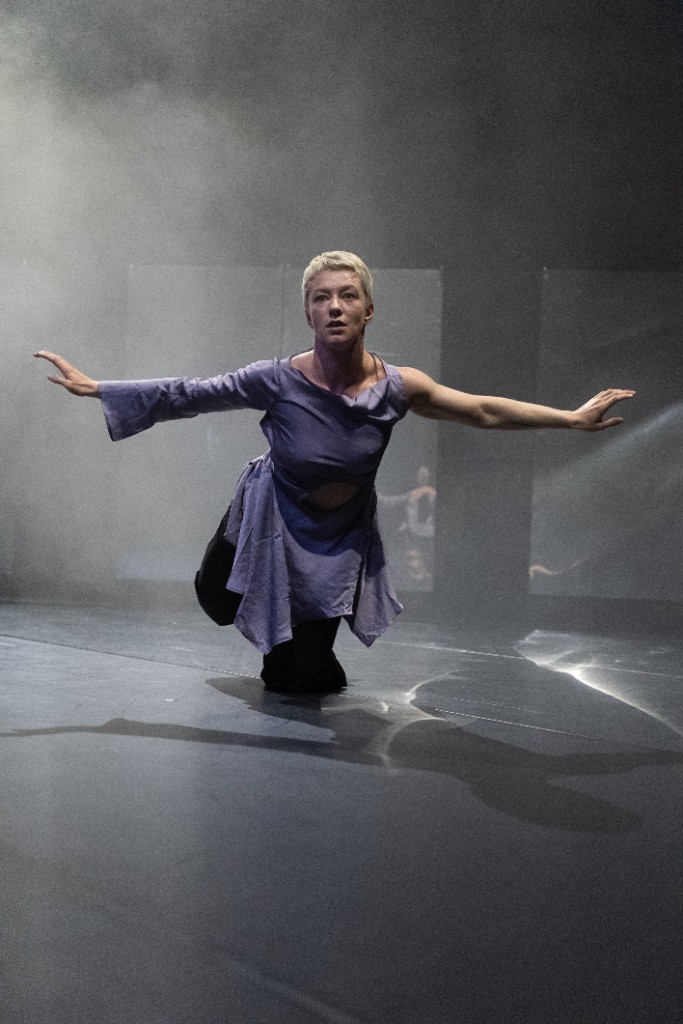
From this question, THE UPRISING creates a space in which protest appears not only as resistance, but as a queer-feminist search
for dignity, connection, and a collective practice of solidarity. Four performers come together and move through various states:
from constructed body images shaped by experiences of restriction and fragmentation, to rebellious collective forms of
protest. The focus opens toward care, exchange, and new networks that listen, offer space for rest, hold, support, and
strengthen. Protest appears not only as individual resistance, but as a collective practice of mutual responsibility — one that
asks how living together can become more just, accessible, and solidaristic. At the same time, it concerns self-determination,
the right to presence, and the possibility of not losing oneself in conflict. Protest thus becomes a movement beyond the self and
beyond present conditions of existence: a fight for visibility, participation, and equality – also for those bodies and
experiences that are socially excluded, marginalized, or rendered invisible.
Through artistic audio description, THE UPRISING approaches protest as a form of collective negotiation in which critique,
care, and accessibility intertwine to create new spaces for connection, support, and transformation.
“Courage allows us to shape a world beyond fear. Protest alone is not enough; relationships matter.”
― Prentis Hemphill
Die Suffragettenbewegung begann in Großbritannien als organisierte Frauenrechtsbewegung, die Anfang des 20. Jahrhunderts mit
teils radikaleren Protestformen für das Frauenwahlrecht eintrat. Frauenproteste sind historisch dort wirksam geworden, wo
private Erfahrung in öffentliche Forderung übersetzt wurde – etwa in Kämpfen gegen Rassismus, für Reproduktionsrechte, für
Rechte von Menschen mit Behinderungen oder gegen geschlechtsspezifische Gewalt. Diese Kämpfe verbinden körperliche
Selbstbestimmung mit kollektiver Sichtbarkeit und verschieben soziale Ordnung nicht nur kritisch, sondern auch praktisch.
Akte der Entschleunigung. Aufbau der Resilienz. Zurückeroberung von Räumen. Brechen von Regeln. Erschaffung neuer kollektiver
Formen.
Wann erkennen wir Erfolg oder Scheitern, wann wird Fortschritt sichtbar? Wann wird Einsatz als Veränderung lesbar, und in
welcher Form wird er weitergetragen? Sichtbarkeit, Schutz und Teilhabe gelten nie als selbstverständlich, wenn bestimmte
Körper immer als politisch markiert, beobachtet, hinterfragt werden und ihre Präsenz legitimieren müssen. Wo stehen diese
Körper, wenn Existenz selbst erkämpft werden muss?
Aus dieser Frage entsteht in THE UPRISING ein Raum, in dem Protest nicht nur als Widerstand erscheint, sondern als
queer-feministische Suche nach Würde, Verbindung und kollektiver Praxis des Zusammenhalts. Vier Performer*innen kommen
zusammen und bewegen sich durch unterschiedliche Zustände: von konstruierten, gelernten Körperbildern – vermittelt durch
Erfahrungen von Einschränkung und Fragmentierung – bis hin zu rebellischen und kollektiven Protestformen. Der Blick öffnet sich
für Fürsorge, Austausch und neue Netzwerke, die zuhören, Raum zur Erholung bieten, tragen, stützen und stärken. Protest
erscheint dabei nicht nur als individueller Widerstand, sondern als kollektive Praxis gegenseitiger Verantwortung – eine
Praxis, die fragt, wie Zusammenleben gerechter, zugänglicher und solidarischer gestaltet werden kann. Zugleich geht es um
Selbstbestimmung, das Recht auf Präsenz und die Möglichkeit, sich im Konflikt nicht zu verlieren. Protest wird so zu einer
Bewegung über das eigene Selbst und die gegenwärtige Existenz hinaus: zu einem Kampf für Sichtbarkeit, Teilhabe und Gleichheit –
auch für jene Körper und Erfahrungen, die gesellschaftlich ausgeschlossen, marginalisiert oder unsichtbar gemacht werden.
Mit künstlerischer Audiodeskription richtet THE UPRISING den Blick auf Protest als eine Form kollektiver Aushandlung, in der
Kritik, Fürsorge und Zugänglichkeit ineinandergreifen und neue Räume für Verbundenheit, Unterstützung und Transformation
entstehen.
Credits
Concept, choreography and dance: Monique Smith-McDowell
Co-choreography and performance: Damini Gairola, Katharina Senk, and Katherine Aileen Osalde Lezama
Concept dramaturgy: Su Jin Kim
Creative audio description: Zwoisaint Mears-Clarke
Audio description performance: Sahra “Zaniah” Abbasi
Choreographic assistance and access dramaturgy: Sophia Neises
Audio description dramaturgy: Naomi Sanfo-Ansorge
Stage design and costume: Raphaela Andrade Cordova
Music: Mona Reichling (Floof)
Light design: Joshua Paul
German translation: Florence Freitag
Production management: Sina Rundel and Uta Engel
Social media & public relations: Kenneth Soussoukpo
Credits
Konzept, Choreografie und Tanz: Monique Smith-McDowell
Co-Choreografie und Performance: Damini Gairola, Katharina Senk, und Katherine Aileen Osalde Lezama
Konzeptdramaturgie: Su Jin Kim
Kreativ Audiodeskription: Zwoisaint Mears-Clarke
Audiodeskription Performance: Sahra „Zaniah“ Abbasi
Choreografische Assistenz und Access-Dramaturgie: Sophia Neises
Audiodeskription dramaturgie: Naomi Sanfo-Ansorge
Bühnenbild und Kostüm: Raphaela Andrade Cordova
Musik: Mona Reichling (Floof)
Lichtdesign: Joshua Paul
Deutsche Übersetzung: Florence Freitag
Produktionsleitung: Sina Rundel und Uta Engel
Social Media & Öffentlichkeitsarbeit: Kenneth Soussoukpo